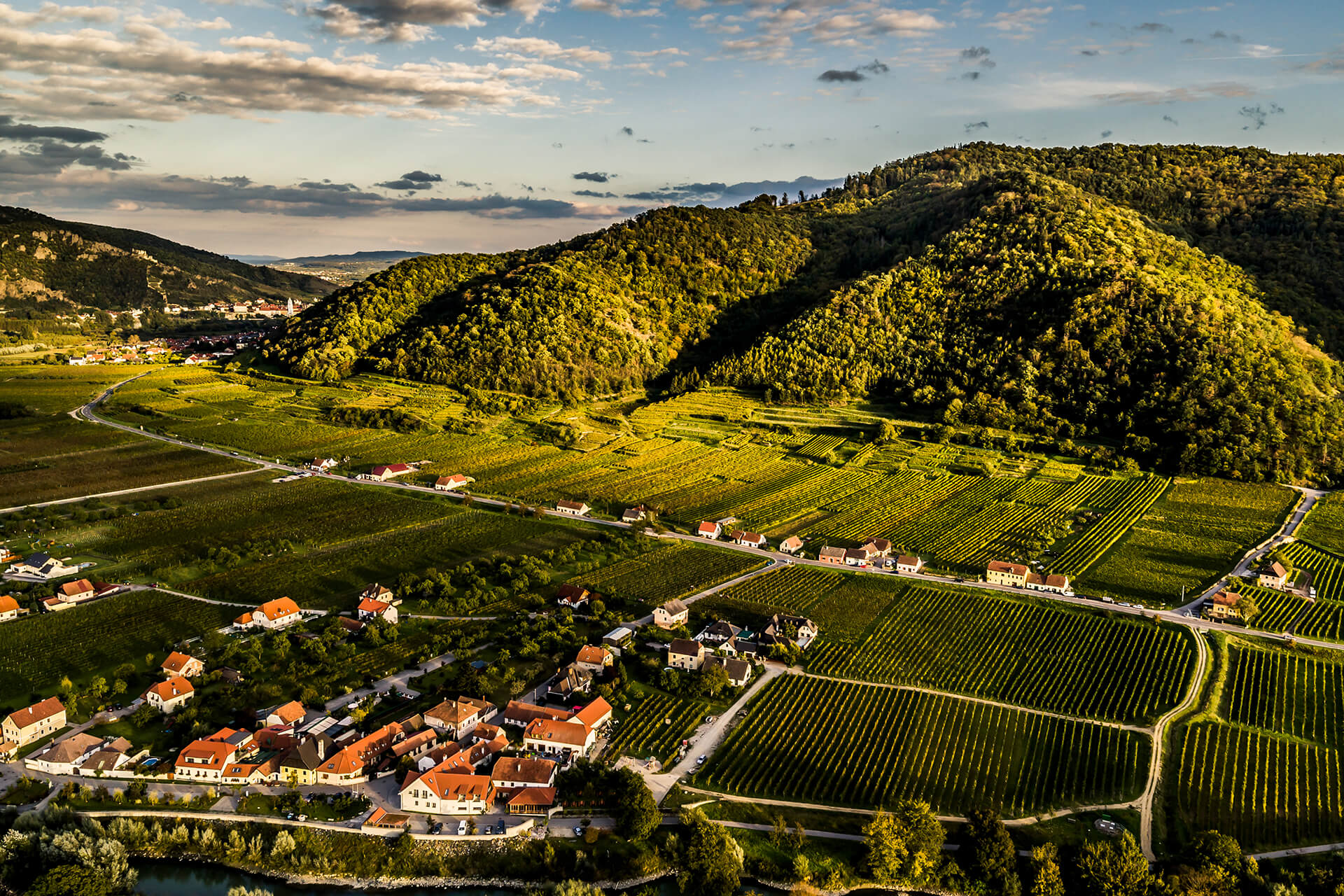
Our most renowned Smaragd – and a very special vineyard for us. The Ried Kreuzberg is located on a cool north-facing slope, where our vines up to 70 years old grow on terraces. The soil is interspersed with gneiss and granite, which gives the wine a distinctive minerality. Due to the high age of the vines, the stocks bear only a few grapes, giving the wine an impressive density and depth – always accompanied by a cool, precise elegance. Fermentation occurs spontaneously in 500-liter barrels, before the wine matures on the fine lees in steel tanks and is bottled in September.
The climate and soil of Kreuzberg are characterized by the transition to the Dunkelsteiner Forest. Cool downslope winds and a complex subsoil of paragneiss and amphibolite result in well-structured wines.
While these wines may not reach the opulence of the neighboring Kirnberg, they are distinguished by their depth and elegance. At the same time, Kreuzberg is home to a species-rich dry grassland that harbors rare orchid species as well as the feather grass that gives the Vinea brand its name.
Despite its north-facing orientation, the vineyards benefit from abundant sunshine throughout the day thanks to their location at the northernmost tip of the Dunkelsteiner Forest.
Stones Tell a Story
Geological Diversity Shapes Wine and Landscape.
At Kreuzberg in Rossatz, two types of rock meet: paragneiss and migmatite-amphibolite. The soil profile comes from the upper area, where the dark amphibolite dominates.
Above the bedrock is slope debris material, which is largely enriched with secondary limestone from earlier loess coverage. Large amphibolite stones are accompanied by yellow feldspars.
Thanks to the northwestern exposure, even a very hot summer can hardly harm the vines. The extended evening sun provides sufficient warmth, thus enabling optimal grape ripeness.